Practitioner Report · 2026 · Free
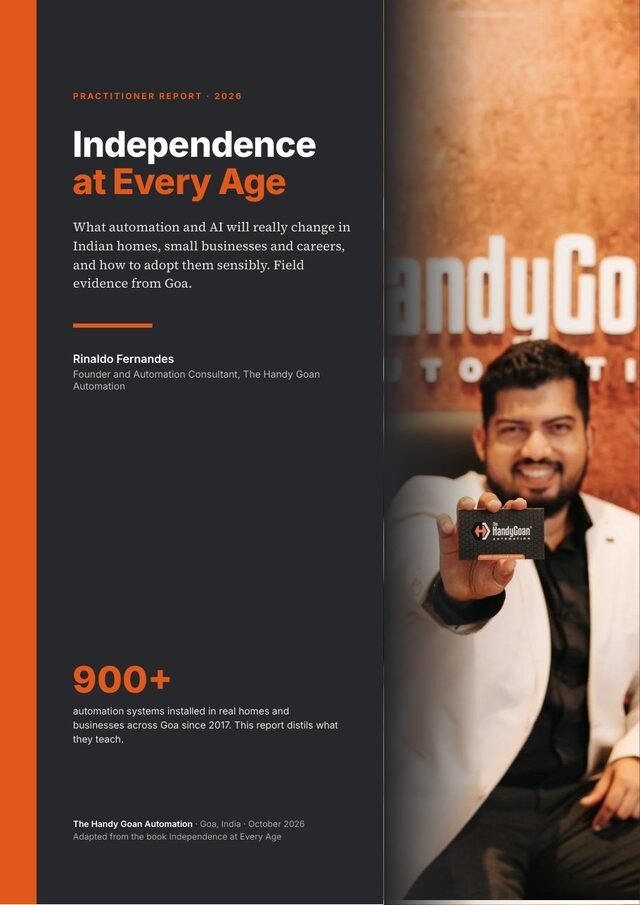
Independence at Every Age
What automation and AI will really change in Indian homes, small businesses and careers — and how to adopt them sensibly. Field evidence from Goa.

- Ten findings from 900+ real installations — what's worth it and what isn't
- Four practical tools: the Worth-It Test, Automate-First grid, seam model and Installer Trust Checklist
- Clear actions for homeowners, business owners, students and the trade
Get your copy
35 pages · Instant download + sent to your email
Executive summary
The machine is the easy part.
The person behind it decides whether it helps.
Most advice on automation comes from labs, newsrooms, metros or Silicon Valley. This report is written from the opposite side: inside the wall, with hands in the wiring.
Sources cited in the report: UNFPA India & IIPS, India Ageing Report 2023 · NASSCOM AI Adoption Index via PIB, 2026 · Technavio, India Home Automation Market, 2026 · Installation figure from company records.
The one test
Does this give a person more control over their own life, or less?
Every finding in the report reduces to that question. It applies to a gadget, a quote, a business process or a career choice. If the honest answer is more independence, safety or dignity, the technology is probably worth having. If it exists only to impress visitors, it will disappoint for years.
Ten findings
What 900 installations actually teach
A preview of the findings. The full report explains each one with real customer stories, worked examples and the numbers behind them.
- 01Automation does. Intelligence decides.Most products sold as "smart" only do a fixed task. Don't pay intelligence prices for a timer.
- 02Families value the plain things most, a year on.People ask about voice assistants. A year later they talk about gates, cameras and stair lighting.
- 03Safety and independence outrank convenience.Of the three returns a good system gives, time is the easiest to oversell. Safety is where the first rupee goes.
- 04Most cost is decided before the walls close.Wiring during a build is cheap and clean. Chasing cable into finished walls is expensive and messy.
- 05Automate the frequent and costly first.How often does it happen, and how much does it hurt when it goes wrong? Simplify before you automate.
- 06The seam works where the job is narrow.Where physical automation meets software, systems deliver on known lists and clear yes-or-no tasks.
- 07Basic functions must survive without the internet.The gate, the lock and the alarm should never depend on the cloud.
- 08The real problem is trust, not technology.Automation is too often sold once and never serviced. After-sales is the product.
- 09A person stays on every consequential decision.Good systems handle the routine ninety per cent and bring people in for the ten that needs judgement.
- 10Smaller markets can leapfrog the metros.Fresh builds, an ageing population and word-of-mouth trust let places like Goa adopt faster and better.
Who it's for
One report, four kinds of reader
Each audience gets its single most important action — and a reading path so you only read what matters to you.
Homeowners & families
Spend first on what protects a person, and wire while the walls are open.
- Start with
- Ch. 03
- Then read
- 02 · 05 · 06 · 07
Small-business owners
Fix the jobs that are both frequent and costly — after simplifying them on paper.
- Start with
- Ch. 04
- Then read
- 02 · 05 · 06
Students & parents
Pair any degree with a hands-on skill, and build a reputation for reliability early.
- Start with
- Ch. 08
- Then read
- 07 · 09
Installers & the trade
Treat after-sales as the product. Document every job and keep service records.
- Start with
- Ch. 06
- Then read
- 05 · 07 · 09 · 10
Inside the report
Ten chapters, written from the installer's side of the wall
Plus a foreword, executive summary, method notes, sources and a glossary.
- 01Why nowAn ageing India, uneven adoption and a market nobody can sizep. 7
- 02Doing versus decidingWhat automation and AI actually mean, and why the difference is moneyp. 9
- 03The automated homeWhat families value a year later, and the Worth-It Testp. 12
- 04The small business and the machineThe Automate-First grid and the owner's-time mathp. 16
- 05The seamWhere physical automation meets real intelligencep. 19
- 06Sold once, never servicedThe trust deficit and the Installer Trust Checklistp. 22
- 07What stays humanJudgement, care and craft, and the human in the loopp. 25
- 08Careers in an automated IndiaThe career that compoundsp. 27
- 09The emerging-market edgeWhy Goa and Tier-2 India can adopt faster and betterp. 29
- 10An agenda for actionRecommendations by stakeholderp. 31
Tools you can use today
Four working tools, used with customers before any money is spent
Decision aids, not statistical models — the same ones our team uses on site visits.
The Worth-It Test
A quick screen for any gadget or quote: does it buy safety, independence or real time — or only a demo for visitors?
The Automate-First grid
Sort every task in your business by how often it happens and what it costs when it goes wrong. Start top-right.
The seam model
Tells you where pairing physical automation with AI works today, and where it's still marketing.
The Installer Trust Checklist
The questions to ask before you hand anyone your walls, wiring and front gate.
From the foreword
"I did not set out to write a report. I set out to fix a gate."
Around 2015, Rinaldo's uncle strained his shoulder closing the heavy iron gate of the family home in Fatorda. That week, Rinaldo automated it. Within weeks the neighbours were asking who had done it.
In 2017 he founded The HandyGoan. His team has since installed more than 900 automation systems across Goa — gates, cameras, lighting, locks and access control — and come back to service them, years later, in the rain.
Read it the way you'd listen to a tradesman you trust at your own kitchen table: what works, what doesn't, what's worth your money, and what he wouldn't fit in his own mother's house.
Rinaldo Fernandes
Founder & Automation Consultant, The HandyGoan · Goa
Free · 35 pages · PDF
Get the report before you spend a rupee on automation
Download it instantly and we'll email you a copy to keep. After that, you can book a free consultation with our team.
Get my free copy